

Against Value in the Arts and Education ed.by Sam Ladkin, Robert McKay & Emile Bojesen,
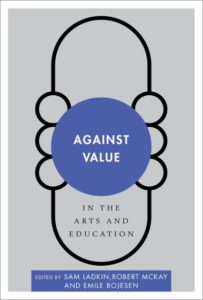 A multi-disciplinary and inter-disciplinary volume exploring the damage to the arts, arts’ funding and education through the rhetoric, manipulation and auditing of value. The collection includes contributions from anthropology, the history of art, literature, education, musicology, political science, and philosophy.

Summary
Against Value in the Arts and Education proposes that it is often the staunchest defenders of art who do it the most harm, by suppressing or mollifying its dissenting voice, by neutralizing its painful truths, and by instrumentalizing its ambivalence. The result is that rather than expanding the autonomy of thought and feeling of the artist and the audience, art’s defenders make art self-satisfied, or otherwise an echo-chamber for the limited and limiting self-description of people’s lives lived in an “audit culture”, a culture pervaded by the direct and indirect excrescence of practices of accountability. This book diagnoses the counter-intuitive effects of the rhetoric of value. It posits that the auditing of values pervades the fabric of people’s work-lives, their education, and increasingly their everyday experience. The book uncovers figures of resentment, disenchantment and alienation fostered by the dogma of value. It argues instead that value judgments can behave insidiously, and incorporate aesthetic, ethical or ideological values fundamentally opposed to the “value” they purportedly name and describe. The collection contains contributions from leading scholars in the UK and US with contributions from anthropology, the history of art, literature, education, musicology, political science, and philosophy.
More information: http://www.rowmaninternational.com/books/against-value-in-the-arts-and-education.
International conference, ‘Modernism, Medicine and the Embodied Mind’- University of Bristol Friday 15-16 July 2016
 Modernism, Medicine and the Embodied Mind: Investigating Disorders of the Self

Project overview
‘Modernism, Medicine and the Embodied Mind’ is an interdisciplinary network that uses the radical insights of aesthetic modernism to develop dialogue with medical practice in psychiatry, psychoanalytic psychotherapy, neurology, and the mental healthcare offered at the end of life. The project is dynamically interdisciplinary, fostering collaboration between researchers and clinicians working in Higher Education, the NHS, and international healthcare. It brings literary and arts scholars, philosophers, psychiatrists, psychoanalysts, neuropsychologists, neurologists, research scientists, and doctors in palliative care and general practice into dialogue with theatre practitioners, dancers and artists from across the UK, Europe and the USA, asking them to explore together the resources modernism offers for creatively understanding experiences of body and mind poorly served by realist models of the self.
The project explores the historical and discursive links between literary modernism, medical discoveries, and clinical practice, in dialogue with the insights of visual artists and art historians, dancers and dance scholars, and contemporary scientists and clinicians. Underpinning the project is the significance of phenomenology and the first-person experience of medicine, as explored in literature, theatre, dance, and the philosophy of medicine, and as applied to medical education and clinical care through innovative performance-based workshops and pedagogical interventions.
Conference details http://www.bristol.ac.uk/arts/research/modernism-medicine/upcoming-events/modernism-medicine-embodied/
Key notes from (another!) International Relations Conference!

Vineet Thakur
University of Johannesburg
For nearly two decades now, the discipline of International Relations has lives on a lament: that it is Eurocentric and we need to de-westernise it. Every year, proponents f non-western IR make their pilgrimage to the Mecca, the annual conference of International Studies Association (ISA) in the US, or, once in a while, Canada, and talk endlessly of why we need to move beyond the West.
Occasionally precinct but mostly verbose, these are no comparison to the arrogance exhibited from the high and mighty. In a panel last year, when the leading IR figure, John Mearshimer was made aware of a whole groundswell of writings on non-Western IR, he said: ‘please ask these scholars to come to the ISA. I would like to listen to them.’
Was there ever a statement more revealing – cocky or innocent, take your pick – of the schism that lies between the mainstream and the margins in IR?
In the first half of January, some of us made the journey, metaphorically cutting right through the globe from the US, to New Delhi. The city was under a thick coat of smog. Pollution levels in Delhi had reached unprecedented levels and the government in Delhi was forced to take drastic measures, including adopting the odd-even rule for the first fortnight of January.
The sense of desperation outside could also be felt inside our conference hall, albeit the nature of the beast was different. A series of workshops – three in total – were organised by International Research on India and International Studies (IRIIS), World International Studies Committee (WISC) and Maulana Abul Kalam Azad Institute of Asian Studies (MAKAIAS) to rethink foundational assumptions of the discipline. It was a remarkably eclectic bunch of scholars from Latin America, Africa, Asia, Europe and North America discussing ways in which the discipline could be ontologically re-defined.
Interesting discussions followed. Hardly a consensus emerged, but it was interesting to see young scholars drawing from a wide range of philosophical sources from East Asia to Latin America. In a discipline, which makes a virtue of its reluctance (mostly stemming out of ignorance) of using non-European sources, this was a hopeful sign. Just last year I had found myself with a group of young scholars at ISA who advised me to tone down the post-colonial approach of my paper in favour of constructivism to make it ‘IR proper’. I had wondered then if almost three decades of interventions from post-colonial scholars was merely inconsequential head-banging. The Delhi Conference was reassuring that it was not/
Towards the end of this journey, my fellow traveler and an IR rebel of old standing, Peter Vale, asked me: have we reached a Kuhnian moment in IR? In his 40 years of struggle against orthodoxy from within the discipline, he seemed, for the first time, I suppose, alive to the possibility that the margins have arrived at the gates of the citadel of mainstream IR, ready to claim it. What a time to be in the discipline, I thought. Bring it on!
What happens when an ‘innovation boom’ leaves the humanities behind?
Howard Manns
Monash University
Linguists by definition are interested in language and the impact it has on society. So, some of us take a perverse interest in the language of government and university policy. Policies are words meant to wield power over people. And, when it comes to government and university policies, the words wield power over us as scholars of the humanities.
A recent media post provided me the onus to reflect on a word that hinted at the past, present and future of the humanities. A journalist from an international arts and culture magazine contacted me about the word innovation. In the lead up to this year’s Australian election, the sitting conservative government has released policy documents promising an innovation boom.
Young people, like the journalist, were curious and sceptical. They wanted a better sense of how the government was using innovation and what impact this might have on Australia’s future. At the onset, innovation seemed to sit within the domain of business for the government.
Innovation: From the humanities to economics
To understand its use, I went back to the start. The word innovate entered English sometime during the 16th century. It derives from the Latin innovatus, the past participle of innovãre, ‘to renew’ or ‘alter’. The element nov in innovate and its predecessor is closely related to the modern English new.
There was an influx of hundreds of Latin borrowings like innovate in the 16th and 17th centuries. Intellectuals of the time doubted whether lowly English words were worthy of high scientific and philosophical concepts. Consequently, one innovation, if you will, to the English language was the introduction of Greco-Latinate words like innovate.
Some of the earliest uses of innovation related to such changes to language, alongside innovation’s use for revolutions, but philosophers and with reference to the state of mankind. In other words, notions of innovation were initially quite closely aligned with the humanities. For instance, linguistic innovations were in the crosshairs of American Quaker Lindley Murray, when he penned his famed 18th century English Grammar.
Yet, the industrial revolution saw increasing use of innovation for technological inventions and innovation’s subsequent use in the domain of business and commerce. In the late 1930s, economist Joseph Schumpeter played no small role in divorcing innovation from its humanities sense, with his focus on ‘Creative Destruction’. Schumpeter, in part through this concept, proposed that a company’s success was tied to its ability to encourage entrepreneurship and institutional change.
Schumpeter’s views gave rise, over time, to innovation economics, which has risen to particular prominence within the past few decades. In support of innovation economics, economist Nathan Rosenberg has written ‘innovative activity has been the single, most important component of long-term economic growth’.
Enter Australia’s Innovation Boom
Schumpeter’s view of innovation, if indirectly, underlies the current vision set out in the Australian government’s policy. Collective references to business/commerce in this policy outstretch those to universities at a rate of 4:5:1. There are frequent references to entrepreneurs (which Schumpeter would certainly approve of) but there are no references to language, culture or anything that might be construes as humanities-related in this policy.
To these ends, I saw where the young journalist was coming from. When government and business conspire about words and meanings, meanings don’t just get changes; words get led down dark alleys and battered.
For instance, as linguist Geoffrey Nunberg notes, the younger Bush administration wielded entrepreneur and innovation as powerful tools for fighting for corporate tax cuts and justifying unemployment figures. Bush argued that corporate tax cuts would impede innovation. Bush extended the label entrepreneur to include unemployed people who were doing odd jobs to make ends meet.
So, what does Australian innovation mean for universities and the humanities? It’s easy to be cynical and say ‘not much’ without hopping into bed with business, even as a part-time lover.
But a linguist playing devil’s advocate might point out the word cynic can be linked to the Ancient Greek kynikos ‘dog-like’. Cynic is a distant relative of the modern English word canine and one popular link between cynics and canines sees them both as shameless ‘snarlers’ at conventional meaning.
With this in mind, it’s worth noting a few positive aspects of innovation in policy, including that of Australia’s newest innovation boom. Such policies encourage collaboration between entities which wouldn’t normally collaborate, like universities and industries.
Moreover, in this economically-minded world, this emphasis on collaboration has an empirical basis. The National Innovation System, upon which documents like the Australia’s innovation boom are based, emerged from the study of nations, like Japan and Germany, which have been successful at facilitating innovation.
The National Innovation System takes as a starting point that the research system’s goal is innovation and maximising the flow of information across a complex set of institutional relationships is among the best strategies for assuring the national success of innovation.
So where next for innovation and the humanities?
In light of the slippery uses of words like innovation and entrepreneur, it’s good to see young people like the journalist, in the words of the late Australian Don Chipp, ‘keeping the bastards honest’. To a certain degree, we do need to be cynical and snarl at conventional meanings of words like innovation, especially when such words marginalize the humanities. Yet, we as humanities scholars might also take on this modern sense of innovation as a challenge and think innovatively about how we can engage with these policies. After all, the humanities gifted innovation to economics and commerce. We should think how innovatively about how we can keep a seat at the innovation table, even if it is now chaired by the more economically minded.
AHHE new article ‘Using close reading’by Helen Brookman&Julia Horn

 Closeness and distance:
Using close reading as a method of educational enquiry in English studies

&
This article draws on a pedagogical case study in order to reflect on the value of using a Humanities disciplinary practice (the ‘close reading’ of literary studies) as a method of educational enquiry and to provide a worked example of this approach. We explore the introduction of a pedagogic strategy – students writing abstracts for essays and sharing them in advance of group discussion – into the tutorial at the University of Oxford, and an evaluation of it. We then read the student ‘texts’ (written abstracts and evaluation forms) more closely, to problematize the initial evaluation findings and reveal hidden aspects of student learning and the teaching relationship. We reflect upon our approach and suggest some of the difficulties and advantages of ‘close reading’ student texts while achieving scholarly ‘distance’ as a pedagogic research practice. In addition, we explore further the relations between social science and humanities approaches to educational enquiry.
AHHE New article ‘The affects of not reading’
 The affects of not reading: Hating characters, being bored, feeling stupid
by , , , , and
Abstract
This article brings recent debates in literary studies regarding the practice of close reading into conversation with Derek Attridge’s idea of ‘readerly hospitality’ (2004) to diagnose the problem of students in undergraduate literary studies programme not completing set reading. We argue that the method of close reading depends on encouraging students to foster positive affective responses towards difficulty – semiotic, emotional and intellectual. Drawing on trials of teaching methods in literary studies’ classrooms in four universities in Australia, we suggest that introducing students to the concept of ‘readerly hospitality’ – rather than assuming an appreciation of difficulty – can better prepare students for the encounters they will have in set literary texts and strengthen the effectiveness of classroom teaching.
New issue of AHHE Academic on Freedom
 Academic Freedom Forum
http://ahh.sagepub.com/content/15/2.toc.pdf
In a previous issue, Nobel prize-winner J.M. Coetzee argued that it was time for humanist academics to take a stand on academic freedom and argue ‘that we need free enquiry because freedom of thought is a good in itself’. In this issue, we follow up this call with a special Forum on Academic Freedom which offers discussion on and around the topic from intersecting views and arguments drawn from both the Global North and the Global South.
Writing from South Africa, higher education specialist Lis Lange worries that a certain ‘depoliticisation’ has ‘infected our fight for academic freedom’, transforming it into ‘a right to disengage… from the deliberation about knowledge constitution, effects, distribution in society and its power’, and with the consequent danger that ‘we are abdicating our moral responsibility to the university and to ourselves as intellectuals’ while a number of reviewers (two from Britain, one from Norway and one from Holland) offer engagements with John Higgins’s Academic Freedom in a Democratic South Africa.
From the USA, Michael Bérubé offers a striking survey of the situation of academic freedom in the USA, with attention to both the intellectual values of the humanities, and the material realities of the increasing casualization of academic labour. Comparative responses come from Raelene Frances in Australia, who questions whether anyone in Australia sees the ‘casualization of academic work as a threat to quality teaching’, while Joachim Wiewiura from Denmark, where ‘students are paid to study’ and theorists of education have emphasized the ‘political need to educate citizens’.
Contents of Special Issue-State of Urgency: The Humanities in South Africa
 Arts and Humanities in Higher
Education
Current Issue
The role of the Humanities in decolonising the academyPrinsloo, E. H.
Letter to John Higgins Coetzee, J.
Reflections on dead theory in International RelationsThakur, V.
Hope as a political category Kentridge, W.
The arts in contemporary South African higher education: Film and media studies Rijsdijk, I.-M.
To be or not to be: No longer at ease1 Ndebele, N. S.
Moving beyond the canon: Reflections of a young African scholar of political theory Omar, A.
Decolonizing the university: New directions Joseph Mbembe, A.
State of urgency Higgins, J., Vale, P.
Njabulo Ndebele in AHHE SPECIAL ISSUE-THE HUMANITIES IN SOUTH AFRICA
AHHE NEW SPECIAL ISSUE-THE HUMANITIES IN SOUTH AFRICA

State of urgency: The Humanities in South Africa (AHHE 15.1)
Njabulo Ndebele ‘To be or not to be, no longer at ease’. Novelist, former vice-chancellor of the University of Cape Town, and academic, Njabulo Ndebele is one of the most respected voices in contemporary South Africa. In his contribution, Ndebele puts his finger on the sore point at the heart of the successive waves of student protest across the country, and writes of the consequences of how ‘I and my generation were without choice educated in a schooling environment that in its content oriented us away intellectually from our formative environments of home and community’. This education resulted in dangerously high levels of alienation as ‘our progressive imaginations progressively got anchored elsewhere’, with the immediate consequence that ‘our own immediate world’ became ‘less real’. At the same time, he suggests that in the growing and visible corruption of the Zuma regime and the new black ruling classes, we are observing the psychic and material dynamics of a situation in which ‘where there may once have been the inner pain of self-degradation, there is now an inner sense of entitlement’.