Addressing Difficult Topics in the Classics Classroom

Rabinowitz-From

Difficult and Sensitive Discussions

From the Introduction to From Abortion to Pederasty: Addressing Difficult Topics in the Classics Classroom by Nancy Sorkin Rabinowitz and Fiona McHardy (Editors) Ohio State University Press (2014)

Discussions of pedagogy on U.S. college campuses have emerged most often from the pressure to change the curriculum following Black power and women’s liberation movements, as well as more recently disability activism and gay and lesbian. While not all faculty members agreed that anything needed to change, in Women’s Studies the curriculum itself generated heightened awareness of the importance not only of the material covered but also of the methods of teaching. Feminist theory and critical pedagogy assume that knowledge(s) are situated and grounded in experience; feminism in particular pays special attention to the personal, noting the inadequacy of attending only to the public domain; finally, it is politically committed, viewing teaching as a means of making change and producing an alternate reality to the hegemonic vision.

Attending only to gender as a factor of analysis was itself critiqued early in the 80s by women of color; since that time, feminism has sought to put forth a complex analysis that takes into account race and class as they intersect with gender. Amie Macdonald and Susan Sanchez-Casal argue for a realist view of identity and an anti-racist pedagogy that takes into account “the complex networks of privilege and oppression that structure all of our identities” (Macdonald and Sanchez-Casal 2002, 5). They further argue that the emphasis on difference does not mean that there can be no objective knowledge: “it is only from within the examination of difference that we can reach for theory-mediated objectivity” (Macdonald and Sanchez-Casal 2002, 7). But if students simply take one course to fill a requirement—either a special diversity course, or a course in Women’s Studies, Latino Studies, or Africana Studies—it will not have a truly liberatory effect. Furthermore, the requirement carries its own risks, for instance, of ghettoization, with issues of diversity and minority politics confined to programs that are taken by self-selecting groups of students. Change comes slowly over time if at all and requires multiple approaches. Therefore, it is very important that students across the curriculum have the opportunity to learn how to engage with the differences that may be present in a text and in the classroom.[i]

For quite some time feminists within the academy have been trying to educate colleagues about the fact the traditional curriculum was, to put it bluntly, sexist; even introductory Latin and Greek text books can be exclusionary. In those new fields, particular attention was drawn to the examples given in text books. Hoover, for instance, comments about Latin textbooks that there is “an assumed audience for textbooks that excludes ethnic, racial, and gender diversity. But the representation of women is disturbing” (Hoover 2000, 58).

How do we change our teaching to take account of the different students in our classrooms? As Too, one of the editors of Pedagogy and Power, puts it, pedagogy was formerly “a dirty little secret, the fearsome and demeaned professional impropriety” but it has acquired more importance in the wake of these challenges to the demographics and the curriculum, in classics as well as in other disciplines. There is a realization that we must address what happens when we change the object studied and the subjects who are studying. Henry Giroux, a philosopher of education, argues that “What is at stake here is not simply the issue of bad teaching but the broader refusal to take seriously the categories of meaning, experience, and voice that students use to make sense of themselves and the world around them” (Giroux 1992: 125). In fact there is a question about how much we can allow our students to speak in “their own voice” in class (Kahn 2005: 1-7, esp.), given the requirements of the disciplines that we have been trained in.

As we think about pedagogy, we may, we must, recognize other ways to liberate the Classics from the past.


English Studies: The State of the Discipline, Past, Present and Future

English Studies: The State of the Discipline, Past, Present and Future


English Studies: The State of the Discipline, Past, Present, and Future, edited by Niall Gildea, Helena Goodwyn, Megan Kitching and Helen Tyson, is an accessible and wide-ranging consideration of concerns facing English Studies and its unique position within the university and society. It intervenes in current debates about the future of English Studies, the Arts and Humanities, and the university itself. Bringing together a proposal for English to be understood as a ‘boundary practice’; an exploration of the study-guide genre; an account of Derrida’s ‘the university without condition’; a consideration of how the subject might negotiate current technological changes and government interventions; the dilemma of cognitive literary criticism; a case study of English and ‘employability’; and the relationship between English in Higher Education and Secondary Education, contributors to this volume draw out the pedagogical ideas that lie at the heart of English Studies, tracing, in the face of current challenges, historical and contemporary debates surrounding English Studies in the university.
 More about the book here.

From the Patricia Cross Future Leaders Awards – Anya Adair

  1. Cross leader adair Anya Adair

      English Language and Literature, Yale

Attending the AAC&U conference as a Cross Scholar has been an inspiring and instructive experience, as well as a great honour.  It’s especially cheering to meet so many people  optimistic about the future of tertiary education, and excited  about the role of dedicated undergraduate teaching in that  future.  Like my fellow Cross Scholars, I’ve been fortunate to  have combined teaching and research throughout my graduate  career, and have benefited greatly from this combination.

My tertiary teaching work began at the University of Melbourne, and included gothic fiction of the eighteenth and nineteenth centuries, early film, Old English poetry, Chaucer, medieval romance and romantic poetry.  At Melbourne and later at Oxford, I led reading groups on various medieval languages, and in these informal settings gained valuable experience working with diverse groups of learners.  I’ve been particularly lucky in the teacher training support available to me: help and mentoring from amazing faculty members like Professor Stephanie Trigg at the University of Melbourne, instruction workshops as part of Yale’s Certificate of College Teaching Preparation, and several graduate subjects in pedagogy.

I’m currently a doctoral candidate at Yale University, with a research focus on medieval English.  My dissertation examines intersections of law and literature from Old to Early Modern English; over the past few years, I’ve published work on the Old English Advent Lyrics and the vocabulary of Beowulf, and am working on projects in late medieval paleography, early medieval emotional vocabulary, and the pronoun choices of Jonathan Swift.  A common thread in all my research and teaching is a fascination with the complexities and potentials of language.  I’m also intrigued by the possibilities that the digital platform offers to integrate the artefacts of written culture into the teaching of language history, and have recently taken up a research post in a project that aims to develop digital teaching resources using the materials in Yale’s Beinecke library.

At Yale, I began my teaching with an undergraduate creative writing class, and last year developed and taught an intensive writing seminar on the theme “Fantasy Worlds”, in which essay writing drills were cunningly hidden behind Disney movies.  I’ve also had great fun giving guest seminars, which have been an important way to get feedback on teaching strategies.  Reading groups at Yale have been richly rewarding too: in these I present on Old English and Old Norse language and grammar, but always end up learning far more than I teach.

The experience of university education has convinced me that three things are necessary for really great teaching: a deep knowledge of one’s field, the conviction that this knowledge is worthwhile, and an urgent desire to share it with others.  There is, I’ve also discovered, a great deal of hard work involved in combining the roles of researcher, teacher, and sympathetic supporter of learning; but it’s all fully compensated for by the fact that an undergraduate once called my description of the Old English weak adjective “fascinating”, and seemed to mean it.


Patricia Cross Future Leaders Award 2015 – Naghme Morlock


Naghme headshotNaghme Morlock is a Ph.D. candidate in the Department of Sociology at the University of Colorado Boulder, concerned with the scholarship of teaching and learning, gender, trauma, and human rights. In her dissertation, Naghme investigates how gender shapes the ways in which members of the Baha’í faith experience, respond to, and cope with the trauma of persecution, the experience of exile and the challenge of religious preservation in the aftermath of mass trauma.

Having developed and taught on-campus, online, and hybrid courses, and published on scholarly teaching and Scholarship of Teaching and Learningshe has been honored with the The Best Should Teach Silver Award and the Betsy Moen Feminist Scholars in Sociology Award. 

Naghme is vocal about her commitment to service work, both in academia and throughout her community. She believes that—as university teachers—we are in a privileged position which allows us to not only teach civic responsibility, but also to lead our students by example. She is actively involved in the American Sociological Association section on Teaching and Learning and this year is serving as part of the Graduate Student’s Concerns Committee. And outside of the university, she has worked with refugee survivors of religious persecution, conducts fundraising for a local Special Education Program, and presents in high schools across the country on Human Rights topics.

Some K. Patricia Cross Future Leaders Award recipients

aacu-logoAAC&U administers the K. Patricia Cross Future Leaders Award, which recognizes graduate students who show exemplary promise as future leaders of higher education; who demonstrate a commitment to developing academic and civic responsibility in themselves and others; and whose work reflects a strong emphasis on teaching and learning.

The awards honor the work of K. Patricia Cross, Professor Emerita of Higher Education at the University of California-Berkeley.

christensenRebecca Christensen, Higher Education, University of Michigan, Ann Arbor

Rebecca studies issues related to equity, inclusion, diversity, and social justice in colleges and universities. Her dissertation is a mixed-methods study focused on the influence of a residential learning community on first-year college students’ social justice conceptualizations, attitudes, and behaviors. She is strongly committed to educating and preparing undergraduate and graduate students to become active citizens and future leaders in our diverse, global society.

connerNeil Conner, Geography, University of Tennessee

Neil studies the intersections between political and cultural geography. His dissertation research explores the politics of national identity, migration, and religion in Dublin, Ireland by examining the growing tensions between native-born Irish citizens and recently arrived immigrants. Interested in geographic education and has conducted research on instructional strategies in introductory-level college courses concerning the dynamics of globalization.

grohsJacob Grohs, Educational Psychology, Virginia Tech

Jacob studies how individuals reason through complex ill-structured problems; he argues that as problems grow in complexity (e.g., wicked problems as described in the problem-solving literature), exceptional technical skills no longer are sufficient for reaching viable solutions: social, economic, political, environmental, and community contexts must also be taken into consideration.

He was Associate Director for Engaged Learning and Scholarship for VT Engage: The Community Learning Collaborative, and lead faculty member for the SERVE Living Learning Community at Virginia Tech.

rentschlerErin Marie Rentschler, English, Duquesne University

Erin’s studies center on 20th   and 21st century American literature and narratives of war, especially novels of the Vietnam War told from the perspective of people of color in the United States.

Her project suggests that these narratives illuminate fissures between individual and collective memories of the war, so posing important questions about what, how, and whom we remember. Her dissertation explores the role of storytelling in making sense of the trauma of war, particularly with respect to those groups of people whose voices have generally been silenced by mainstream Vietnam War representation. By examining the tensions between lived experience and imaginative narratives, she draws attention to the physical, emotional, and psychological suffering that pervades both racial or ethnic conflict and war. It ultimately offer these stories as a point of access through which readers can enter into the pain and suffering of an “other” and develop the capacity for the kind of empathetic understanding that underpins cross-cultural communities of healing. She hopes that her project will contribute both to the critical discussion of fiction representing a particular historical moment and to conversations about teaching controversial and sensitive topics such as war, race, and ethnicity.

In teaching literature, Erin often works with her students to examine the roles that narratives (and their readers) play in memorializing, commemorating, and documenting life in the context of complex historical moments such as war or cultural conflict. She fosters an environment that allows students to reflect on their roles and responsibilities as individual citizens who dialogue with the myriad narratives that they encounter and who have the potential to shape how current events are remembered and how diverse groups perceive and interact with one another.

She is now  program manager for the Center for Teaching Excellence at Duquesne.

The Interdisciplinary Scholar: Pushing at Boundaries, Feeling Bound

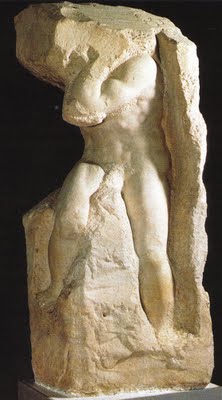
michelangelo slaveThe Interdisciplinary Scholar: Pushing at Boundaries, Feeling Bound

by Monica Prendergast, Department of Curriculum & Instruction, University of Victoria

I am an interdisciplinary scholar in theatre studies and drama education with interests in aesthetic philosophy, performance studies, curriculum studies and arts-based research. My doctoral degree is in Interdisciplinary Studies and was awarded in 2006 by the University of Victoria, where I was fortunate enough to land a faculty position in 2011. Yet my position is in the Faculty of Education and is therefore held to be within an area of the social sciences. Thus I am a drama/theatre education scholar whose roots are entirely bound in the arts and humanities, although my life has branched me out into a home in the social sciences.

Education is an inherently interdisciplinary field, housing as it does scholars from language and literacy, mathematics, science, social studies, philosophy, history, psychology, physical education and the arts. Framed as a social science, however, educational research and discourse becomes fraught with expectations that it be empirical and ‘scientific’ (often for political rather than pedagogical reasons). How does this work when it comes to aspects of education that are rooted in the arts and humanities? In many cases, and in my own experience, not very well.

I long for a university structure that allows faculty members to move with more fluidity and hybridity across disciplinary boundaries. A university such as mine offers interdisciplinary doctoral degrees but not interdisciplinary faculty appointments that can support those who wish to work in more porous ways in the academy. I do work productively with colleagues in other areas, of course, in both graduate supervision and research. But I do not teach in those areas, nor can I weigh in on aspects of (say) a Fine Arts program that lie within my expertise, such as curriculum design and delivery. These boundaries can chafe over time.

My recent and current research projects and publications speak to these border-crossings of interdisciplinarity. Based on my readings in utopian philosophy (primarily by Fredric Jameson and Ernst Bloch), I became interested in analyzing drama education through those lenses. I posited that the kind of improvised roleplay called “process drama” offers students and teachers a kind of utopian space in which hierarchies can be suspended in favor of collective envisioning and exploration of better worlds. The “what-if” of classroom drama becomes the “not-yet” of Bloch’s anticipatory consciousness in his Philosophy of Hope.

            Most recently, my funded research is around developing a new curriculum for secondary level students in performance studies. Performance studies is currently only taught in postsecondary institutions. Yet I believe that the interdisciplinary foci of performance studies in understanding art, politics, economics and culture as forms of performance would be of great interest to younger students. My graduate and postgraduate research assistants and I are writing this curriculum with chapters on Performance as Play, Ritual, Healing, Education, Identity, Power and Everyday Life. I am seeking continuing funding to implement and assess this new course in multiple sites across Canada and in Australia.

Methodologically, my commitment to performance-based and poetic inquiry has proven endlessly rewarding. My closest colleagues are those who, like me, consider research and scholarship to be creative and artistic practices. We carry on our work, pushing against the boundaries, finding our way.

New faces of feminism in the [Classics] classroom?

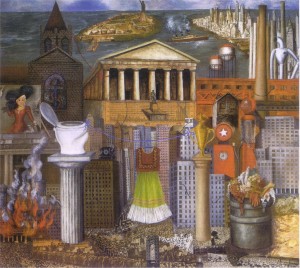
my-dress-hangs-there-1933

The ‘Classics and the new faces of feminism’

international ‘sandpit’ at the Institute of Classical Studies opened by challenging us to think about whether and how we could/should incorporate in our teaching and research the achievements of ‘3rd wave feminism’.

Barbara Gold, Hamilton College:’Today we accept gender, sexuality, narrative theory and intertextuality as inseparable from our reading of texts but are (most of us) so informed by such approaches that we cannot conceive of a scholarly analysis or pedagogy that does not engage with one or more theoretical approaches? Today we no longer have to explain (to most people at least) that “sex,” “gender” and “sexuality” are socially-constructed categories, that they are performative and evolving, and that these elusive categories need to be seen in a grid intersecting with other constructed categories like class or race (an often elided or ignored category)?’

Some answers:

*Sneak it everywhere into the curriculum and strategic conversations

*Fight for the reintroduction of gender into modules

*Tackle citation rings – cite and use female/feminist authors, scholars, translators

*Tackle the canon: other authors, genres, language forms? (eg, Medieval authors who wrote ‘feminine Latin’ , like Heloise, Hildegard of Bingen….)

*Resist resistance – gender issues are so last century! Caesar’s Gallic wars not interstitial spaces for us!


‘Historians on Teaching’ is now live

historians teaching

The website ‘Historians on Teaching’ is now live – www.historiansonteaching.tv. It features historians in Europe, Australia and North America talking about their teaching and their lives as university teachers. The 200 or so short clips together provide insights that will assist individuals, departments and the discipline community as a whole to reflect on, talk about and enhance the practice of teaching.

This project was designed and implemented by Alan Booth and Jeanne Booth, and features many members of the HistorySOTL community.

The International Society for the Scholarship of Teaching and Learning in History

The Future of History

Mills Kelly at EdWired:

In the December 2013 issue of Perspectives, AHA Executive Director Jim Grossman wrote a very interesting essay on the future of history education in America: “Disrupting the Disruptors.” I couldn’t agree more with Grossman’s premise that higher education is a public good and deserves to be treated that way. Alas, as a recent report by the GAO makes clear, all across the country legislatures are inexorably defunding public higher education. And there is no reason to believe this reality is going to change.

In his essay Grossman also makes a strong pitch for the value of a traditional liberal arts education in the face of the disruptions in the higher education business model brought to us courtesy of those who would “unbundle” the degree. I too am a passionate defender of the value of a liberal arts education. I think that as a nation we are making a big mistake if we turn our backs on the value of the liberal arts to our economy, our political and social system, and to our citizens.

Where I have to part company with Grossman, however, is where his argument that an unbundled degree is “a narrow and often isolated experience compared to the liberal education that is available in the hundreds of institutions across the nation that offer curricula, rather than courses.” Alas, that ship has already sailed.

Read the rest.

CFP: Oxford English Graduate Conference 2015 on Value

CFP: Oxford English Graduate Conference 2015 on Value

What’s aught but as ‘tis valued?’
William Shakespeare, Troilus and Cressida, II.ii, 53

In times of austerity, it is more than ever essential that what and how we value, and the far-reaching effects of any such valuation, be closely examined. The need for such attention has become particularly urgent within universities, where recent reductions of funding have sparked a sharp increase of debate over ‘the value of the Humanities’. With that in mind, the Oxford English Faculty Graduate Conference 2015 invites papers on all aspects of ‘value’, as a concept that has, and will always inspire great passion, and great controversy.

The concept of ‘value’ has the ability to shine light in dark corners, to illuminate what goes unspoken or unacknowledged in a society or in a text. How is value attributed to one thing and not to another? Is value always historically and socially contingent? Or is there anything that can be considered universally valuable, such as basic rights? Is value always a moral issue? More particularly, how has value functioned in texts throughout time, and how does that affect the value that we attribute to texts themselves? What, in short, can be learnt from the literature of value, and the value of literature? And how have these values been reflected in the academy, in what we study and how we study it?

Contributors may consider, but need not be limited to:

  • Texts that reflect certain values, and how they are constructed.
  • Markers of value: use and usefulness, difficulty, religious significance, political engagement, artistic integrity etc.
  • Valuations along lines of gender, racial, national, linguistic and sexual difference.
  • The combining and clashing of distinct value-systems.
  • Valuation in material culture: money, wealth, and commodity, especially in the literary marketplace.
  • The idea of intrinsic versus commodity value.
  • The relationship between aesthetic and ethical values.
  • Value and the canon: ways in which one set of texts becomes valued above another.
  • Formal value: emphasis and accent within texts.
  • Value and editorial decision: the formation of the ‘authoritative text’.
  • The value, or non-value, of certain methods and approaches to the study of literature.
  • Attempts to resist the allocation or expression of value; hidden or concealed values; the power of assumed values.

Applications are welcome from graduate students at all stages irrespective of institutional affiliation, and working on all aspects of English Studies. Proposals are invited for twenty-minute papers, to be delivered as part of panels of three. Individual proposals (of 250 words), and panel proposals (of up to 700 words), for three papers that interact under a common theme, are accepted.  Please send proposals to value.conference@ell.ox.ac.uk.

The deadline for submissions is 23rd February 2015. The one-day conference will take place on Friday 5 June 2015.