Politics of Language Teaching: Still a Crisis?

Phipps and Gonzalez

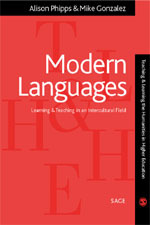
Call for responses to Modern Languages:

Learning and Teaching in an Intercultural Field

by Alison Phipps and Mike Gonzalez

(hailed in 2004 by Henry Giroux as ‘filled with so much wisdom, critical insight, and sheer humanity that it takes one’s breath away.Reclaiming language as both a site of struggle and a crucial sphere of politics matters of language lie at the heart of any viable pedagogy in which democracy matters.’)

CALL FOR FORUM ON THE THE POLITICS AND PEDAGOGY OF LANGUAGEAHHEcrop
Proposals and responses to Editor-in-Chief, Arts and Humanities in Higher Education: an international journal of theory, research and practice ahheresearch@gmail.com

From Phipps and Gonzalez ch.1  ‘Politics of Languages’

THE CHALLENGE WE FACE WORKING TOGETHER WITH WORDS…

There is a profound crisis in modern languages. The number of students applying for undergraduate courses is declining, and the siren voices asking what ‘use’such courses are grow more shrill by the minute. Emergency conferences gather to define the origins of the coming disaster, and to justify the continuing existence of modern languages in terms of the values that prevail throughout higher education. Mergers of departments across institutions are offered up on the altar of‘viability’ and ‘efficiency’ – the twin shibboleths of a new managerial layer trained in the ethics of consumption and profitability. An alternative response is to justify the survival of their departments by reference to a university-wide ‘market’ for languages; new degree courses marrying languages with management or law or engineering, for example, are enthusiastically offered as a way forward. Languages as commodity These, and other similar responses have two features in common: they are defensive, and they concede without a fight the concept of languages as ‘skills’, technical adjuncts to the real business of managing, engineering, drawing up contracts and so on. A principled advocacy of modern languages as an intellectual discipline full of possibilities, a source of understandings and insights that can empower and enrich human life, is rarely if ever heard.

THERE IS MODERNISATION…AND MODERNISATION The challenges we face are unavoidable. The greatest error, however, would be simply to turn our back and reject them as ‘bad modernisation’. The situation is far more complex. The imagined ‘good old days’ when a disinterested humanism prevailed, to the extent that they ever existed, were double-edged. The dominant high culture, for example, gave short shrift to the broad spectrum of cultural products and activities not contained within the narrow literary canon. It was an intellectual culture that was overwhelmingly elitist, narrow-minded and discriminatory towards marginalised or minority expression. And while it made obeisance to a concept of tradition and thus to historical processes, its historicism was often mechanical or irredeemably idealist in its refusal to anchor the life of the spirit in the terrain of the material. On the other hand, the move towards ‘performativity’or skills, for all its potential limitation of the speculative spirit, has given a new legitimacy to oral forms, communicative competences and areas of non-academic knowledge (from popular culture and storytelling to ritual and performance).

The growth of interest in applied linguistics and the new disciplines of foreign language education and second language acquisition, have been another, perhaps unintended, consequence. As they have gained ‘legitimacy’ within the academy, they have begun to contribute important research to the study of literature, for example through their concern with literacy.

‘Applied language’ As modern language departments have moved increasingly towards ‘applied language’, another potential conflict has become apparent. Kelly (2000) highlights the possible contradiction between the private and the social purposes of language learning, on the one hand, and on the other the specific purposes of applied language in particular fields, as language departments and centres have moved into areas like business, law and medicine as well as anthropology and sociology. Projecting the logic of the process into a probably not very distant future, Kelly points ahead to a situation in which there would be no language degrees as such, but only language study associated directly with each separate discipline (Kelly, 2000: 91). While he refrains from suggesting how this might be resisted or addressed politically, he makes clear what the long-term consequences are likely to be. Language departments would be transformed into service units, providing skills additional to the core capacities required by other areas of professional activity. In other words, languages will be uncoupled from what we see as the central activities of languaging, being intercultural and living with supercomplexity. For the modern languages teacher or scholar in higher education, the effect would be a massive deskilling, a devaluing of all those areas of human knowledge and understanding which, as we argue throughout this book, can and should be the necessary and liberating outcomes of the study of modern languages and their cultures. The irony, of course, as we suggested earlier, is that the impact of that process of deskilling will fall on those who, having learned the discourse of humanist criticism and literary analysis, will return to an increasingly performative higher education environment as teachers – almost certainly at low rates of pay and on short-term contracts which offer no opportunities at all to contest the shape and direction of higher education.

Winter School in Psychiatry, Philosophy and Neuroscience

Wellcome med hums imagewtp052625

Winter School in Psychiatry, Philosophy and Neuroscience (University of Otago, 21-24 June 2015)

Overview:

We will be providing a mixed learning opportunity involving presentations and case-based problem solving workshops, with the aim of encouraging and supporting integrative thinking in neuroscience, psychology, psychiatry and philosophy. The presentations and discussions will cover a range of clinical and ethical questions, as well as theories of disease and illness in the broader context of philosophical inquiry. We will address such questions as:

  • “What is the relation between evolutionary thinking and human neurology?”
  • “How do biological accounts of brain function correlate with clinical presentations?”
  • “How should we regard marginal and alternative therapies such as conversion therapy, exorcism, natural healing, and cultural approaches to healing?”
  • “In what way should neuro-scientific and philosophical thinking influence debates in law and mental health?”

The inclusion of knowledge from philosophy, psychiatry and the basic sciences means that the winter school aims to enhance the ability of clinicians and scholars working in both humanities and basic sciences to share insights, in order to bring alternative perspectives to bear on contested issues in psychiatric epidemiology and nosology. It is hoped that the course will bring together and offer something to clinicians, academics and researchers in these areas and psychological medicine.

Programme:

  • Day 1, Sunday 21 June – ‘Evolutionary Neurology and Psychosurgery’
  • Day 2, Monday 22 June – ‘Psychoses as Insanity Syndromes and Brain Disorders: Science, Philosophy and Law’
  • Day 3, Tuesday 23 June – ‘Developmental and Personality Disorders: Socio-Political Psychiatry’
  • Day 4, Wednesday 24 June – ‘Psychiatry and the Margins: Culture, Post-Modernism, Mental Disorder’

The course can be attended in its entirety or on a pick-and-choose day-by-day basis. It is hoped that the latter option will provide an attractive way in which a wider group of attendees (apart from the core 20 students) will be able to benefit.
The cost for this course is $400 for all 4 days or $125 per day

This course will be taught by: Professor Grant Gillett (Bioethics), Dr Neil Pickering (Bioethics), Professor John McMillan (Bioethics), Dr Richard Mullen (Psychiatrist); Dr Christopher Ryan (University of Sydney, Psychiatry); Professor Paul Glue (Psychological Medicine, University of Otago); Professor David Bilkey (Psychology University of Otago); Professor John Dawson (Law, University of Otago)

To register please email  Grant.Gillett@otago.ac.nz

CONTINUING Q-How do we do defend the Humanities? 1of our A’s: Humanities and the Liberal University Special Issue

CONTINUING Q-How do we do defend the Humanities? 1of our A’s: Humanities and the Liberal University Special Issue

AHHEcrop

Special Double Issue: Humanities and the Liberal University: Calls to Action and Exemplary Essays

A special issue of writings from and inspired by Arendt, Attridge, Barnett, Bhabha, Clarke, Deegan, Derrida, Evans, Heaney, Kanter, Mandela, Moltow, Ndebele, Nussbaum, Stimpson, Strathern, Tagore, New Voices, and Editors.

From the introduction, by editor-in-chief Jan Parker:

How do we do defend the Humanities? How do we stave off anti-liberal agendas? How we make our universities fit for [liberal] purpose?

Our answer has always been, by our writing – advocating and illuminating the values inherent and produced by our ‘skill-ful’ meaning-making practices – on campus, in the virtual classroom, in the community.

[…]

This Special Issue has been convened in difficult times, in response to a gathering sense not just of institutional and political opposition to the Arts and Humanities, but to the urgent need, internationally, to promote our subjects as higher education. So, we have brought together leading thinkers – many of whom were founder members of our editorial board and also were involved in the seminal AHHE ‘Future Priorities of the Humanities’ forum – to reflect on the prominent Humanists with whom they have worked and who inspired them.

More http://bit.ly/1Jnmosh

February/April 2014; 13 (1-2)

Special Double Issue: Humanities and the Liberal University: Calls to Action and Exemplary Essays

Screening – Mirrors to Windows: the Artist as Woman 5th June 2015, 18:00 London College of Fashion

Mirrors


London College of Fashion Screening,  5th June 

Mirrors to Windows: the Artist as Woman

is a documentary film by Emmy and Peabody Award-winning director, Susan Steinberg. The film takes you on an intimate but fast-paced journey into the lives of three generations of international artists, all living and working in London. Moving the lens between art and life, it reveals the dynamic and multifaceted story of this enigmatic calling. This event follows a sold-out screening at the Royal Academy of the Arts for International Women’s Day.

After the screening there will be a Q&A with curator Kathleen Soriano, filmmaker Susan Steinberg, and Charlotte Hodes.

Tickets for the event are priced at £10, and can be booked at: http://estore.arts.ac.uk/browse/product.asp?compid=1&modid=2&catid=24

Trailer – From Mirrors to Windows: The Artist as Woman


McGann: Truth and Method; or Humanities Scholarship as a Science of Exceptions

gadamer truth and methodgadamerMcGann on ‘Truth and Method; or Humanities Scholarship as a Science of mcgann-jeromeExceptions’

14 May 2015, 17:00 – 18:30, Mill Lane Lecture Theatres, Cambridge

Professor Jerome McGann (University of Virginia) will give a Cambrdge Centre for Research in Arts, Social Science and Humanities (CRASSH ) public lecture http://bit.ly/1KzmVbA:

‘As my title suggests, Hans-George Gadamer’s dialectic of enlightenment is my point of reference. I mean to recover and revise Gadamer’s thought by shifting it from a philosophical to a philological perspective. From the living example of certain individuals, I propose a model of humanist enquiry that seems to me worth preserving and emulating, particularly now when educational policy is reinvesting so heavily in a technical expertise offered by the STEM disciplines (Science, Technology, Engineering, Mathematics).’

OPEN TO ALL

JOURNAL FREE TO DOWNLOAD FOR 7 DAYS

AHHEcropArts and Humanities in Higher AHHELogo-e1420559902593Education: an international journal of theory, research and practice

Special Issue: Forum on the Public Value of Arts and Humanities Research           http://ahh.sagepub.com/content/14/1.toc

Special Double Issue: Humanities and the Liberal University – Calls to Action and Exemplary Essays        http://ahh.sagepub.com/content/13/1-2.toc

A Special Issue of writings from and inspired by Arendt, Attridge, Barnett, Bhabha, Clarke, Deegan, Derrida, Evans, Heaney, Kanter, Mandela, Moltow, Ndebele, Nussbaum, Stimpson, Strathern, Tagore, New Voices and Editors 

Special Issue: Theorising Practice in Creative and Applied Arts  http://ahh.sagepub.com/content/13/3.toc


A Response to The Guardian’s article “The War Against the Humanities at Britain’s Universities”

Having now read this article, I have come to realise that *surprise, surprise*, the heading is totally there for inflammatory purposes. This wasn’t simply an article going through the motions of discussing cuts to humanities funding and a governmental prejudice against the arts and humanities in higher education, but a detailed piece with information gathered from a variety of academics discussing what the current impact upon humanities subjects in universities is in the lead-up to the coming election.

One of the most striking aspects of the article was the admission that universities are effectively being transformed into profit-creating institutions, with a focus on this over the education of students. One only has to look at the recent campaigns in London and across UK universities for Free Education to know how important this issue has become to many students and academics. A great deal of bile has been spewed up by both the media and students themselves as universities take greater authoritative steps towards clamping down on these protests, almost to an alarming extent.

Interestingly, the article did admit that academics of STEM subjects as well as humanities were concerned about the future of academia (thus effectively defying the title of the article). The abyss between the pay that chancellors, vice chancellors and high-end management are receiving in comparison to the academics that are effectively the reason why the university is able to make money is particularly under scrutiny in this article. This really showed that things need to change. The article suggested that we are effectively heading down into a totalitarian extremist state, in which academics are forced into creating courses with the highest profit potential with a lack of regard to student desires.

What I found missing from the article was an acknowledgement of the impact that the changing attitudes is having upon the mentality of students at higher education institutes themselves. There is an awareness now that by doing a STEM subject you will ultimately reach a greater earning potential, and sadly this does sway the decision of many young people. Moreover, the reminder that humanities students are in some way ‘inferior’, which I as well as many of my peers receive through a disparaging look when informing someone that I am a humanities student, does have a negative impact upon one’s mentality. Having paid an equal amount to our peers, and with an obvious love for our subject, it can be rather saddening to be viewed in this way, and make the choice to study a humanities subject receive a greater deal of scrutiny.


What are your experiences regarding this issue?


Stephanie Hartley

Assistant Editor

Just publishedin AHHE-Stories on the Skin:Tattoo Culture at a South Florida university

stories_on skin02-2015“Stories on the Skin: Tattoo Culture at FAU”AHHEcrop

by Karen J Leader

a multidisciplinary creative and research project, has explored and presented tattoos as a shared cultural experience, rather than as a symptom, or a fad.

http://ahh.sagepub.com/content/early/2015/03/16/1474022215575162.full.pdf+html

Tattoo emerges from multifaceted, multi-domain study as a repository of memories and a site of affirmations, but also a significant form of creative self-expression beyond temporary fashion.

Proposing a positive value to connecting mind and body, story and skin, the project offers a model for other universities to engage a diverse student body in the complexities of living an embodied self in a virtual world. It also offers a way to open the minds of those who would discriminate. It is not about promoting, but about understanding, this moment of ink, deploying the arts and humanities for the sake of self-knowledge and tolerance.

Calling Philosophy postgraduates: design a module!

PlatoAristotleThe UK Philosophy revised ‘Benchmarks’ have just been published http://www.qaa.ac.uk/en/Publications/Documents/SBS-philosophy-15.pdf

How would you teach the subject of your research to university students?

Outline your ideal course in 500 words for publicAHHEcropation here and in a Special Issue of the journal onTeaching Philosophy in Higher Education – Principles and Impact

RESPOND HERE AND ALSO SEND TO the AHHE Editor in Chief ahheresearch@gmail.com

From Subject Benchmark Statement UK Quality Code for Higher Education Philosophy February 2015

The basic principles of this framework concern subject matter, method and aim of study.
  1. Philosophy seeks to understand, and critically to question, ideas concerning the nature of reality, value and experience that play a pervasive role in understanding the world and ourselves. Problematic concepts, such as existence, reason and truth, occur in every sphere of human enquiry. Others belong to particular areas of thought and practice, such as art and politics.
  2. Philosophy has been practised for thousands of years, and in many different cultures, giving rise to a diversity of traditions. Students of philosophy may be, and in single honours programmes generally are, introduced to works originally written in different languages, in different historical periods. This gives the subject great intellectual breadth.
  3. The vitality of philosophy is enhanced by the existence of a plurality of approaches, and the maintenance and development of distinct (though overlapping) traditions.
  4. Philosophy is open-ended, changing and extending its range both by its own internal dynamic and also by encompassing new problems generated from outside itself.
  5.  No one method suits all philosophical problems, but philosophy is characteristically done by such means as asking questions, trying out and critically engaging with ideas, making and sharpening distinctions, inventing new vocabularies, criticising and reinterpreting major texts, examining issues that arise in the history of philosophy, using formal techniques (such as logic and the probability calculus), constructing and assessing reasoned arguments, conducting thought experiments, or marshalling evidence from relevant sources.
  6. Philosophy is not a rare specialism or ‘minority subject’, to be fostered in only a few centres. The central aim of philosophy is to understand the world and our place in it, and for this reason philosophy is considered to be at the heart of higher education, wherever it is offered.
  7. Philosophy is a part of the humanities, but its importance extends into many other areas of intellectual enquiry. Subjects such as the philosophy of physics and of biology are increasingly important. The philosophy of social science is relevant for social theory. For example, distinctively philosophical questions arise in considering the central concepts employed in biology (fitness, optimality), economics and business (markets, information, fairness, and policy making (privacy, ownership, interests). The connection between logic and the development of computing is well known. Philosophers have shown themselves very ready in recent years to tackle practical issues, for example, in such areas as applied and professional ethics. Philosophy is both analytical and systematic, taking its own history seriously. Through international links of many kinds, the study of philosophy in the UK connects fruitfully with its study throughout the world.
  8. The study of philosophy may make up any proportion of a degree programme, and the specific objectives of study properly vary accordingly, and may vary also depending upon what other subjects, if any, are in the student’s programme. The overall aim for all students studying philosophy is to gain a deep understanding of some pervasive and problematic features of the world and of ourselves.
  9. Philosophy nurtures a wide variety of skills. However, the skills that may be reasonably expected as the outcome of a full single honours degree are not all produced by a single philosophy module.
  10. The heart of philosophy is a set of modes of thinking acquired through rigorous training. Philosophy, with its stress on independent thought, is by its nature an open-ended subject, constantly being revised and extended in the light of new insights and new problems. Yet its history, at least in the Western world, stretches back for 2,500 years. There is a balance to be drawn in a Statement such as this between being excessively prescriptive about the content of a philosophy course and writing banal platitudes. The dilemma is encapsulated by the fact that great philosophers such as Socrates or Wittgenstein resisted the idea that philosophy is simply a body of knowledge to be taught. At the same time it is usual for someone fully trained in philosophy to know something about some figures such as Socrates or Wittgenstein.

Calling Post Graduate New Voices:How would you teach your interests?

AHHEcrop

Publish the answer here and in

Arts and Humanities in Higher Education: an international journal of theory, research and practice               http://ahh.sagepub.com

Interested in delving deeper into current debate concerning the arts and humanities? Or want to know what top academics think about topics ranging from classics and the new faces of feminism, to how religion and difficult issues ought to be taught in schools? Signing up to the AHHE blog site will give you the opportunity just that. This blog site has been created as an additional resource for the Arts and Humanities in Higher Education international journal. Connect with other postgraduates by signing up here:  http://eepurl.com/ba4Ujv.

Plus, we offer the chance for you to write for us: yourself: Postgraduate Network blogs will build into and be published in the journal as international New Voice fora.

How would you teach your disciplinary interests? Propose your ideal course here! (as a response or by email to <ahheresearch@gmail.com>)

What do you think universities should look like in 2020? Respond here! (as a response or by email to <ahheresearch@gmail.com>)

Or, answer a post on this site from your discipline (see buttons, top right) or

WHAT IS REALLY ‘HIGHER’ ABOUT HIGHER EDUCATION?

THE INTERDISCIPLINARY SCHOLAR: PUSHING AT BOUNDARIES, FEELING BOUND

[HOW] ARE THE ARTS AND HUMANITIES ‘LIBERAL’?

If you’re considering heading into academia this is a great step forward!

From The Editor in Chief,

Dr Jan Parker, University of Cambridge