A&HHE Special Issue August 2016
The h-APP-ening: a transmedia improvisation project
Hannie van Veldhoven
Abstract
In 2014, HKU University of the Arts Utrecht realised a research project in transmedia improvisation. The aim was to develop possibilities for art students to engage in reciprocal improvisational dialogue, each bringing techniques, skills, and ways of expression of their own discipline to the interactions. Students were required to improvise through different media, engaging the different art disciplines. Technology students developed software tools to connect the instruments of musicians and facilitate interaction between sound and visual media. The project as a whole was innovative in its demands for working at an interdisciplinary level. It revolved around the students, who were given great responsibility to explore the nature of improvisation and the creative processes of different disciplines.The project raised intriguing questions, including how to develop equal capacity for different art disciplines to communicate through improvisation, and how to find a common language to communicate within the improvisatory and interdisciplinary ensemble.
Keywords
interdisciplinary, student-centered, projectbased, research project, improvisation, transmedia, jazz, pop, art disciplines, higher art education
Introduction
Improvisation is a natural way to communicate for jazz and pop musicians, but for some other art disciplines it is a far less familiar part of professional practice. When different art disciplines seek a common way to communicate artistically ‘in the moment’, improvisation can be a vehicle to facilitate this kind of interaction, although the context clearly presents challenges.
Part of the mission of HKU University of the Arts Utrecht (the Netherlands) is to find ‘new practices and new solutions’, especially in the interdisciplinary field[1]. Interdisciplinary improvisation is therefore an interesting area for investigation. Specific questions in this context are:
- What kind of improvising ‘dialogues’ can be generated across artistic disciplines?
- How can improvisation be developed in ways that generate reciprocal exchange and mutuality across artistic disciplines?
- How can interdisciplinary or transdisciplinary improvisation connect aspects of time, space, sound and vision?
- How can analogue/acoustic instruments relate to live electronics or ‘virtual realities’ in the context of improvisation?
- How can students of different artistic disciplines establish shared ground and a rich dialogue, working on the basis of their own ‘instruments’, techniques and skills, and with a view to using improvisation to create a performative and interactive presentation?
In 2014, a practical research project was launched by the Jazz&Pop department, to explore how musicians’ improvisation practices can relate to other art disciplines and work in collaboration with them. The pedagogical basis for this project was active learning and self-discovery: students learning through experience in projects (Haak & Hoobroeckx, 2002). This meant that no formal teaching as such was offered during the project, and the students worked mostly independently in peer groups. They were seen as experts in their disciplines, and together they were required to find their own solutions for completing the project. Teachers took on the role of facilitators of the learning process, sharing their professional experience with the students when asked. The project was evaluated in stages by students and teachers from the various departments, where both processes and products were evaluated at given moments and redirected if necessary.
Pilot project: research at the HKU Media and Performance Laboratory (Maplab)
HKU Maplab researches interdisciplinary creative processes and mixed reality technology. As a pilot for the project as a whole, eleven students and five teachers (Jazz&Pop, Music Technology and Theatre) were given the opportunity to experiment collaboratively and freely in this laboratory over a period of three days: research through practice. The students were asked to consider their own discipline as an ‘improvising performer’. They chose which instrument to use and experimented with playing it and improvising with it on the spot. The instruments ranged from traditional instruments like saxophone, guitar, drums and keyboard to xbox controller, midipad, laptop, digital theatre lights, wiimote, radio, projectors and DIY hardware interface. The students experimented with all kinds of free improvisation, based on text, images, videos, colours and emotions, etc. Insights from this research, as investigated by Versloot (2014)[2] included:
– Finding a shared artistic understanding is not easy. Participants sometimes discovered that their perspectives were quite different, despite working in an integrated way.
– Approaches to teaching/coaching are not the same for each discipline. It appeared necessary to find common approaches to, and shared values in teaching.
– Differences in pedagogical styles can (and should) be used strategically. Drawing attention to the differences and the way to inform decisions about the artistic process can benefit all disciplines.
– Where the focus is on understanding different learning strategies, it is important not to be too worried about the outcomes of the product. Teachers and students placed great value on the opportunity to research in a context where the product was not judged.
– Teachers have to decide how they can best play a role: guide from the sideline or join the students in the process. In music, it is quite common that a teacher plays and improvises together with students. This was not so familiar to other disciplines and it sometimes inhibited some of the students.
– To enable reciprocity between disciplines, all participants need to have a similar level of command of their own ‘instrument’. All the students had the impression that the Jazz&Pop students were far ahead in mastering improvisational skills, while the other students (Music Technology and Theatre) were still finding their way.
This resulted in not all students being able to respond directly to each other at all times. Only when disciplines are equivalent can they respond directly.
The research days raised many questions to be further investigated in the project, as well as generating incredible curiosity and enthusiasm for the potential of such collaboration and a desire to pursue the issues further.
‘I felt like I could really express myself, as I had created the means of expression. If I had 15 years to master my instrument, my performance would indeed be different. However, I did not feel disadvantaged in any way. In fact, I felt the exact opposite, as the instrumentalists had to stay within the paradigm of their instrument, whereas I had the chance to create my own’.
Part 1: a transmedia improvisation production called ‘LUIM’
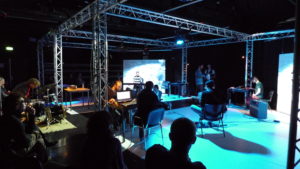
The pilot was followed by a collaborative production, on which fifteen students from the departments Jazz&Pop, Creative Writing, Theatre Design, Interactive Performance Design and Media&Technology worked full-time for six weeks. Some of these students had also taken part in the Maplab pilot, in which they investigated ‘what is my instrument?’ The focus in this production was on ‘how and what do I improvise with my instrument, and what do I want to bring about?’ Five teachers from all the disciplines were involved, coaching the students in various surroundings at the different departments.
The logistics of this project were quite complex. There were differences in department schedules, in ways of preparing meetings, in students’ artistic and logistic needs, and in expectations during the interdisciplinary group rehearsals. As far as perspectives on artistic results were concerned, what seemed natural to one discipline did not seem so to another. This made the meetings quite confrontational for teachers as well as students, although everyone was convinced of the artistic challenge involved.
To achieve transdisciplinary collaboration as defined by Jochem Naafs (2010)[3], students provided each other with as much improvisational freedom as possible. They frequently changed the leadership of the rehearsals, giving an opportunity to all art disciplines to ‘direct’ an improvisation from the perspective of one discipline towards the others. It taught them a lot about their own discipline. The students had to put in words how their discipline worked, what they meant by doing things, how they wanted to express themselves, and what their artistic goal was when improvising. Only at the end of the project, as the presentation drew near, did they decide to base the improvisations on some kind of rough storyline. The final presentation was a live performance, where the lines between the disciplines were blurred, and where the improvisational story was told ‘through the different disciplines’. The audience, sitting in the middle of a hall, were surrounded by a transmedia totality of sound, visuals, texts, music and movement.
‘I’m used to just designing things, so it was fun to work as a performer for a change. I became a musician doing my thing, as forms produced a sound at a certain moment. Or I could make an image drawing of 2-3 lines based on what was around me.’
Part 2: a multimedia improvisation event called ‘The h-APP-ening’
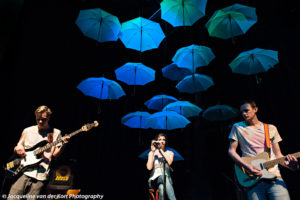
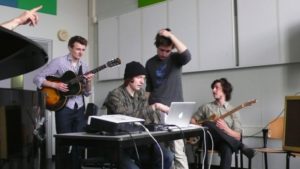
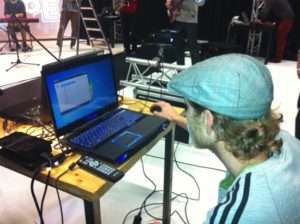
The final part of the project involved a ‘pressure cooking collaboration’. Sixty Jazz&Pop students and six Music Technology students came together and worked intensively for a week. The students were coached by artists with lots of experience in multidisciplinary activities. The students encountered similar problems to the group who worked on the transmedia production. The music technologists needed time for the technical aspects of their laptops, wires, digital connections and software programmes, while at the start of the week the musicians just took their instruments, waiting to play together, but yet not knowing how to communicate with the technologists.
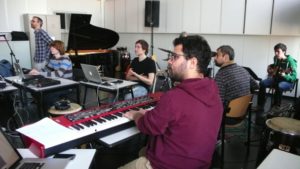
During the week, different ways of working were practiced, depending on the need at the moment. There was a small concert hall for the group sessions and the presentation, and multiple rooms where students could work separately. Sometimes, the teachers and students came together for general discussions of specific issues, and sometimes the music and technology students worked together, partly coached by teachers and partly working independently. Technologists and musicians gave regular peer feedback, discussing how things were progressing in the various ensembles.
The greatest challenge was finding a balance between ‘leading and following’ the multidisciplinary improvisations and between using non-prepared and fully prepared musical or technical material. Students experienced the intersection between the disciplines, where the pathway becomes unfamiliar and uncertain. Once again, communication appeared a very important element. During the week, when students got to know each other better, there was a growing sense of mutual trust, which is indispensable for artistic and improvisational freedom.
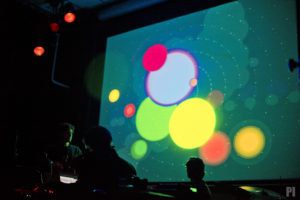
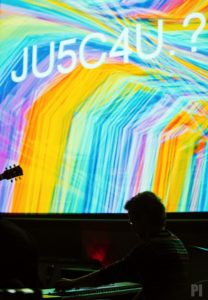
The presentation at the end of the week showed interesting and diverse results: musicians improvising on moving and changing visuals on large screens, and technologists improvising with their visuals on hearing the music and the improvisations.
I learned:
‘…that technology can teach you a lot about music’.
‘..how to use music with visuals, and when one of the two is more powerful for the audience’.
‘… that it is important to think about how to keep an audience’s attention, and by what means’.
‘…how advanced the technology for combining visuals and live music is, but also how difficult it is to make something interesting out of it’.
Conclusions
Improvisation can be a powerful tool for co-creation between disciplines. However, an important condition for achieving this is the ability to play and improvise on an equal footing with other disciplines. Discovering how to express yourself in your art discipline through improvisation and how to play in the moment itself is clearly not the same for all disciplines, and necessitates the development of improvisational skills. Awareness of the possibilities of creating in time, space, sound or vision is indispensable for interdisciplinary creation. By using the methods, media and techniques of each others’ disciplines, students can reach one another in collaboration. This awareness needs time to develop, for teachers as well as for students. Arts universities can provide the necessary conditions for this, by organising and supporting meetings between disciplines on many different levels.
The development of interdisciplinary didactic strategies is important in higher art education in order to improve reciprocal improvisation across artistic disciplines. Different arts universities have completely different educational structures. Differences were encountered particularly when comparing analogue to digital, and performing arts to non-performing arts. Teachers will need time and space in order to develop didactic strategies beyond their own discipline.
Different arts universities will have to be flexible in their logistics concerning organisation, students’ study load and curriculum development. Collaboration must be viewed as a priority in order to solve all kinds of practical problems and other differences between the arts universities and their organisations.
And last but not least: communication is incredibly important. Teachers and students of different art disciplines have to be able to meet up, not only on the ‘shop-floor’, but also informally – meeting, talking, having dinner together and exchanging ideas, values, and discipline-specific issues in order to be able to understand each other and eventually communicate artistically in a free, creative, improvisational and transdisciplinary way.
This research can be developed further by, for example, accomplishing structural improvisational collaboration between arts universities, in public participation (e.g. through using apps) and in the further development of improvisational narrative by using transmedia storytelling techniques.
Footnotes
[1] http://www.hku.nl/Homeen/AboutHKU/HKUUniversityOfTheArtsUtrecht.htm
[2] http://annamariaversloot.nl/blog/?portfolio=keuze-is-beheersing
[3] “A collaboration where disciplines are (deliberately) not seen as separate, and where the lines between the disciplines are (deliberately) blurred. The individual elements from all the disciplines are used by ‘throwing all the ingredients into a bowl together’. By using the methods, media and techniques of each others’ disciplines, the collaboration thus becomes a transdisciplinary work of art”.
References
Dam G ten, Hout H van, Terlouw C and Willems J (1997) Onderwijskunde hoger onderwijs. Handboek voor docenten. Assen: van Gorcum.
Naafs J (2010) Relaties in het transdisciplinaire maakproces. (Master’s thesis, Universiteit Utrecht). Retrieved from http://dspace.library.uu.nl/handle/1874/37523
Versloot AM (2014) Available at http://annamariaversloot.nl/blog/?portfolio=keuze-is-beheersing